



Create your nutrition list
To start, click the button. Follow the prompts, and create your nutrition list.
It’s your choice - with our knowledge.
It’s your choice - with our knowledge.


Popular Brands
Popular Products
Popular Hydration Brands
Popular Recovery Brands
Popular Health Brands

Triathlon fuelling is all about balance. You need enough carbohydrate to sustain power on the bike, something easy to digest on the run, and a format that fits into race logistics without slowing you down in transition.
Energy chews sit perfectly in that middle ground. They are compact, easy to portion, and give you quick-access carbs without the bulk of bars or the stickiness of multiple gel wrappers. For Olympic and 70.3 distance racing especially, they can be a smart addition to your fuelling strategy.
For most triathletes, chews work best on the bike. It is easier to chew safely and maintain rhythm compared to the run. A simple strategy might look like:
On the run, switch to softer chews or combine with gels if intensity is high. Always practise this in training to make sure texture and timing suit your race pace.
If you are unsure how many carbs you should be targeting per hour, our Nutrition Calculator can personalise this based on your weight, predicted time and race distance.
Before diving into specific products, it’s worth understanding what actually matters on race day.
Carbohydrate content per serving: Aim for around 60 to 90g of carbohydrate per hour on the bike for most athletes, and slightly less on the run depending on intensity. Chews typically provide 20 to 40g per pack, so they are ideal for topping up alongside a carb drink.
Texture and chewability: You want something soft enough to eat at race pace, but not so sticky that it becomes hard work. On the bike, firmer chews are fine. On the run, softer options often feel easier.
Electrolytes or caffeine: Some chews include sodium or caffeine, which can be helpful in hotter races or later stages when focus and power start to dip.
Portion control: Chews are naturally divisible. You can take one or two at a time rather than committing to a full gel in one go, which makes them ideal for controlled fuelling.
Here are some top picks:
VOOM Pocket Rocket is a popular choice for triathletes who want a high-carb chew in a compact format. Each pack delivers a strong carbohydrate hit, making it ideal for structured fuelling on the bike.
The chews are soft, easy to break into smaller pieces, and available in flavours that are not overly sweet, which can be a real benefit deep into a race.
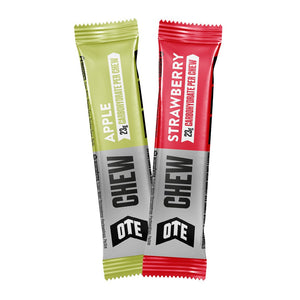
OTE Energy Chew offers a softer texture that works well at race intensity. Each pack delivers a meaningful amount of carbohydrate in an easy-to-consume format, designed specifically for endurance athletes.
These are particularly effective on the run leg of a triathlon when you want something lighter than a bar but still substantial enough to keep energy levels stable.
Guava Energy Blocks offer a real-food alternative to traditional chews. Made from natural guava paste, they provide simple carbohydrates in a firm but easy-to-chew block.
For longer triathlons such as 70.3 racing, these are particularly useful on the bike when you want a change from gels and drinks. You can slice them into smaller pieces before the race and work through them gradually, which helps spread carbohydrate intake across the leg.
Are energy chews suitable for long-course triathlon?
Yes. When combined with carb drinks or gels, chews can form part of a 60 to 90g per hour strategy for middle and long-distance racing.
Can I rely only on chews for my bike leg?
You can, but most athletes find a mix of chews and carb drink easier for hitting higher carbohydrate targets comfortably.
Do energy chews cause stomach issues?
When practised in training and used within your personal carb tolerance, most athletes tolerate chews very well. Start with lower amounts and build up gradually in your sessions.
Energy chews are a versatile and practical option for triathlon. They allow you to:
The best choice will depend on your race distance, intensity and personal preference.