





Create your nutrition list
To start, click the button. Follow the prompts, and create your nutrition list.
It’s your choice - with our knowledge.
It’s your choice - with our knowledge.


Popular Brands
Popular Products
Popular Hydration Brands
Popular Recovery Brands
Popular Health Brands

Product Insights
Discover more about the products in this article

Guava Energy Blocks
Featured Products
Gravel events like The Gralloch demand more than just strong legs. Long hours, technical terrain, changing conditions and sustained intensity mean fuelling has to be thought through well before race day arrives. To give you a real look behind the scenes, we asked athletes from the XMiles Performance Team to share exactly how they approach fuelling before, during and after racing.
While their quotes are not written specifically about The Gralloch, the principles translate perfectly to a long, demanding gravel event where consistency, simplicity and confidence matter most.
Below, we break this down into before, during and after, using the athletes’ own words, alongside guidance on why they do it and how you can apply the same thinking on race day.
Before race day even arrives, both athletes place huge importance on fuelling in training. The goal is not to find something exciting on race week, but to remove uncertainty entirely.
Gravel racing adds extra variables. Rough terrain, technical descents and changing weather all increase stress on the gut and make fuelling harder to manage on the fly. Practising in training allows you to discover what works when fatigued, under intensity, and when handling the bike demands focus.
For your own race day, this means fewer decisions, less anxiety, and more confidence standing on the start line.
In training, my fueling approach is about testing and learning. I use sessions to trial different energy drinks, chews and formats so I understand what my gut tolerates at different intensities and under fatigue. This allows me to dial in what works for long sessions, harder efforts and technical off-road riding, rather than guessing on race day.
Kerri-Ann treats training as a fuelling laboratory. Every long or hard session is an opportunity to learn what the body can tolerate when things get uncomfortable.
In training, I am always looking to practice fuelling choices and strategies so that come race day, there are no surprises and I am not trying anything new.
I race across a range of different types of disciplines; road triathlon (middle and full distance, off road triathlon, time trialling and cross country mountain bike.
Lydia’s approach is built around repeatability. By fuelling the same way across multiple disciplines and sessions, race day becomes execution, not experimentation.
In training, I look to use predominantly more natural fuel sources and love the Guava Energy blocks and Active Root sources of nutrition to help with this. I consider the type of session I am doing, the intensity level and the other training sessions that I might have the same or following day to help me to decide my fuelling strategy for training.
A lot of my training starts between 05:30 - 06:00, so I am always making sure I've had a small snack pre training, like a banana and a Cold Brew protein coffee to kick start the day. For key training sessions, I will have a pre planned nutrition strategy. For me, the reason I put a lot of emphasis on my training fuelling is for; practice, session quality and recovery.
For riders heading into events like The Gralloch, this reinforces a simple idea. Train your gut the same way you train your legs.
Once the race starts, complexity is the enemy. Both athletes emphasise simplicity, accessibility and regular fuelling.
In gravel racing, technical sections demand attention. Missed feeds or poorly timed fuelling can quickly lead to energy dips that are hard to recover from. A simple, familiar fuelling system allows you to fuel without breaking rhythm.
For your race day, this means choosing formats that are easy to carry, easy to consume, and tested well in advance.
On race day, my fuelling is deliberately simple. I mainly use chews as they’re easy to carry, quick to take on board and practical for off-road racing where the terrain is technical and attention needs to stay on the bike. I store them in my top tube bag so I can fuel regularly without stopping or disrupting rhythm.
This approach is especially relevant for gravel events where stopping can cost momentum or positioning.
By separating experimentation in training from execution on race day, I arrive at races confident in my fueling and able to focus purely on performance.
Confidence is the hidden advantage here. Knowing exactly what you are taking, and when, frees up mental energy for pacing and handling.
For my race nutrition strategy, I have a baseline plan which I keep the same and then make tweaks, based on the type of race that I am doing. For a road based triathlon on the bike, I look take on around 100 - 120g carb per hour.
Lydia builds around a baseline rather than reinventing her plan for every event.
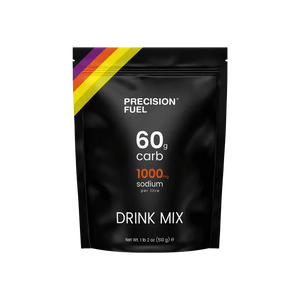
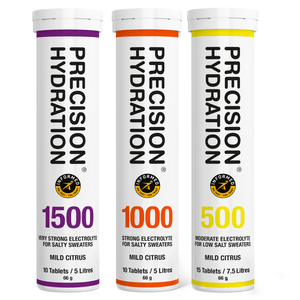
For a road based triathlon, I decant Precision Hydration pouch into my downtube bottle and then carry 2 x 500ml bottles with Stykr 90g carb with caffeine mix and add in a Precision Hydration 1500 electrolyte mix. On my top tube bag, I carry 226ers caffeine gels and maybe even a cheeky mini snickers just to mix it up.
The same logic applies to gravel racing. Liquids, gels and chews are placed where they are easiest to access while riding.
For an off road triathlon, I follow a similar approach and will often have Precision Hydration pouches to hand for the bike and run as these can be easier to quickly take on nutrition in sometimes muddy conditions and also, courses where you have to be quick to take fuel on (so you want a big hit) due to the technical nature.
For gravel riders, this highlights the importance of choosing fuelling formats that work in poor conditions, not just perfect ones.
During a long distance mountain bike race, I might incorporate more solids and do use Voom bars and have used Supernatural fuels energy pouch (rice pudding flavour) as I am not having consider any GI issues as there is no run off the bike. I still look to target between 100 - 120g carb per hour and use the same strategy as I would for a road based triathlon for my baseline fuelling.
Again, the principle is consistency. The products may change, but the structure remains the same.
Fuel does not stop mattering when the finish line is crossed. Both athletes place value on recovery as part of their overall fuelling strategy.
Events like The Gralloch take a serious toll on the body. Glycogen stores are depleted, muscles are damaged, and hydration levels are compromised. Refuelling promptly supports recovery, reduces soreness, and helps you return to training sooner.
For most riders, this means planning post-race nutrition in advance, not relying on whatever is available at the finish.
Access to choice and flexibility plays a key role in both athletes’ approaches. Having everything in one place allows them to test, refine and personalise their strategies without compromise.
XMiles plays a key role in supporting my training and racing by giving me access to a wide range of nutrition options in one place. That variety allows me to test different products properly in training and make informed choices about what I use in competition.
Rather than being locked into a single product or approach, XMiles helps me build a fuelling strategy that’s based on experience, not guesswork. By the time I’m on the start line, I know exactly what works for me and what I can rely on under pressure.
XMiles supports my training and racing by providing me with a way to really individualise my nutrition strategy and enhance my recovery. I am able to mix brands in a way that means I am not having to compromise at all, I can have all the products that work for me and also, can test out new ones in a really cost effective way.
The key takeaway from both athletes is simple. Fuelling is not about copying someone else’s products, but about copying their process.
Test in training.
Simplify on race day.
Fuel consistently.
Recover properly.
If you do that, you give yourself the best chance to ride strong from the first climb to the final gravel sector.